



Resources for Parents
Community Resources
- Autism Speaks Resource Guide
https://www.autismspeaks.org/directory
Provides a directory of services and supports for various needs.
- A Parent's Guide to Special Education
https://portal.ct.gov/-/media/SDE/Special-Education/Parents_Guide_SE.pdf
A resource guide for parents about special education.
- Center for Children's Advocacy
Provides information, programs and resources to protect children's legal rights in Connecticut and promote child wellbeing.
- Connecticut Parent Advocacy Center
Provides information and support to families impacted by children with disabilities ages birth to 26.
- Respite: A Parent's Guide
Resource guide for parents/guardians regarding respite care for their child with special needs.
- Respite: A Child and Adolescent Guide for Families and Care Givers
Resource guide to help parents/guardians share information with respite provider about their child with special needs.
- State of Connecticut Department of Developmental Services
Information about individuals with disabilities and community resources.
- State of Connecticut Department of Aging and Disability Services
https://portal.ct.gov/ads/programs-and-services
Programs and services offered by the State Department of Aging and Disability Services, formerly the Department of Rehabilitation Services, for individuals with disabilities.
- 211/Infoline
Infoline helps connect individuals to essential health and human service resources in their community. Infoline also connects the community to emergency mobile psychiatric services (EMPS) for children and youth experiening a mental health crises 24 hours a day/7 days a week.
Informative Handouts about Autism Signs and Symptoms
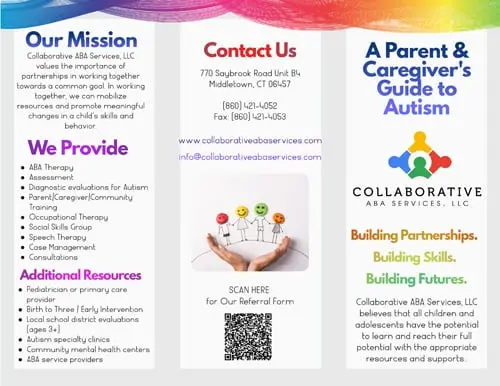
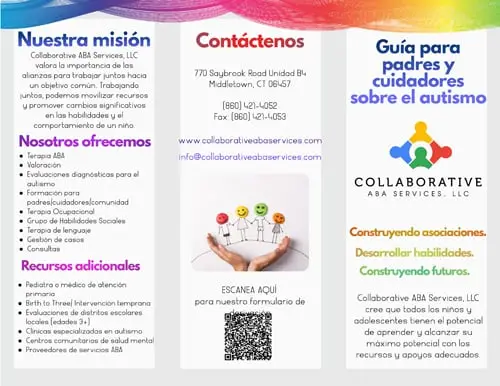
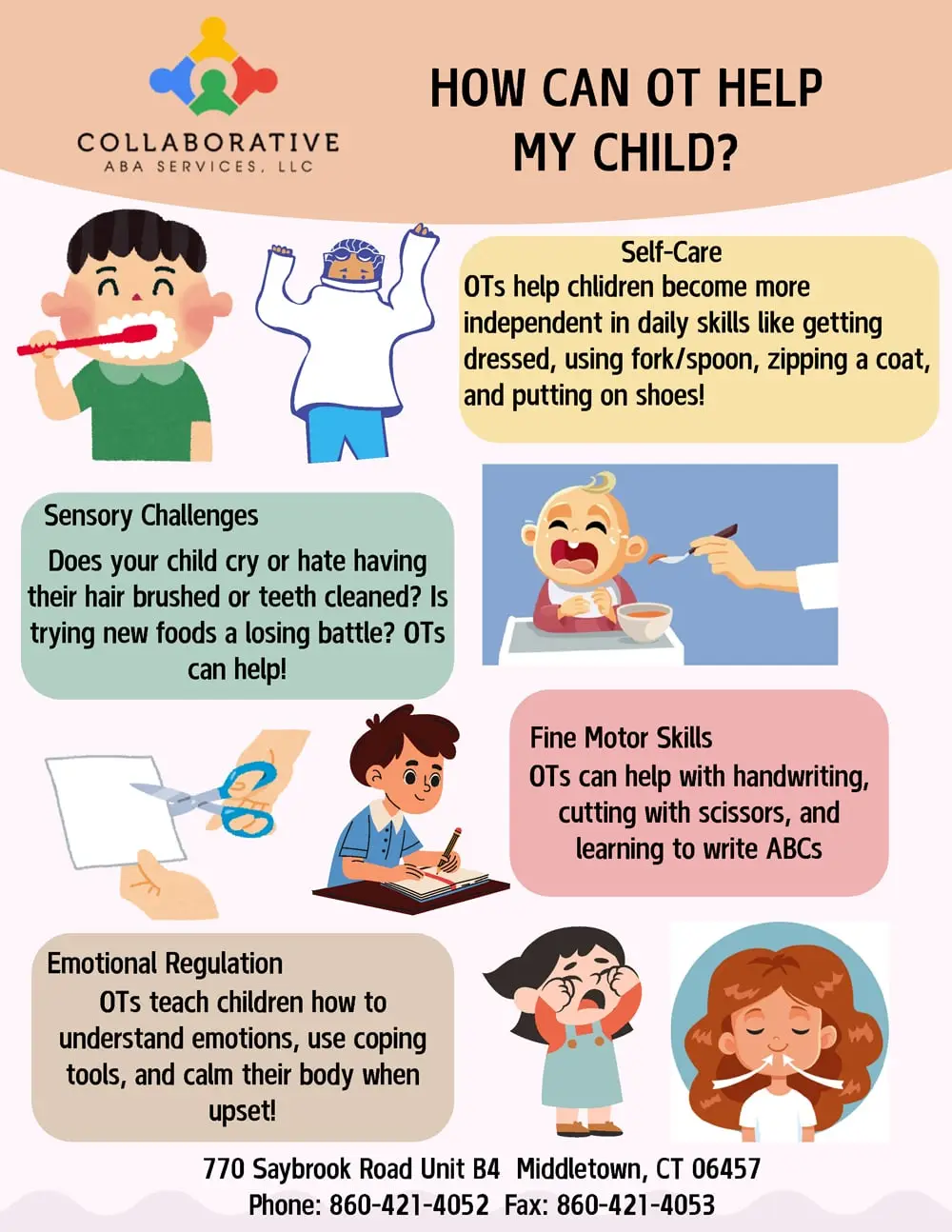
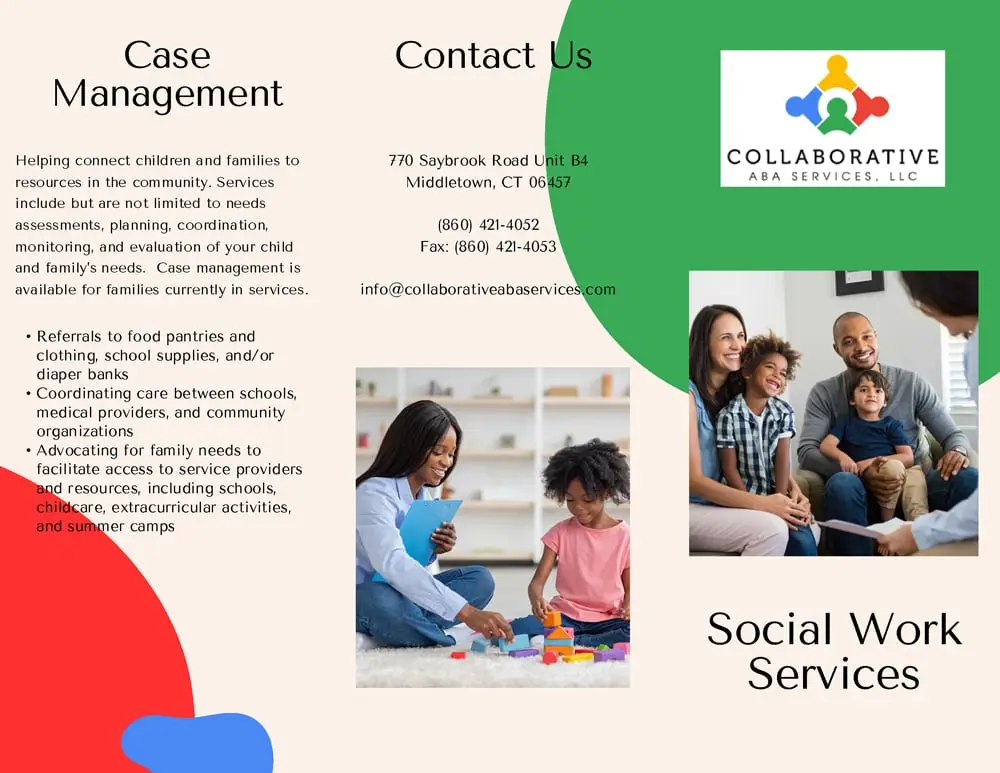
New Information about Our Occupational Therapy Services and Social Work Services
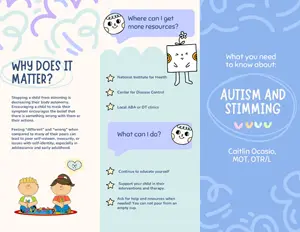
Our New Brochure:
What You Need to Know about
AUTISM AND STIMMING
by Our Staff Member Caitlin Ocasio, MOT, OTRL
Glossary of Common ABA Terms
- ABC Data Collection:
- Collecting observable information on the events that occurred before the behavior (antecedent), what the behavior looked like (behavior), and what happened after the behavior occurred (consequence).
- Baseline:
- Data taken before intervention (what the child does before teaching/intervention is given).
- Discrete Trial Training (DTT):
- Method of teaching a skill by breaking the skill down into smaller trials/steps.
- Errorless Learning:
- Teaching strategy designed to minimize or prevent learner errors.
- Extinction:
- Withholding reinforcement for a particular behavior that was previously reinforced.
- Fading:
- Removal of prompts to promote independent correct responses.
- Generalization:
- Ability to apply what is learned across different settings and people.
- Negative Punishment:
- The removal of something in the environment after a behavior, that results in the behavior occurring less frequently.
- Negative Reinforcement:
- The removal of something in the environment after the behavior, that results in the behavior occurring more frequently.
- Positive Punishment:
- The addition of something in the environment after a behavior, that results in the behavior occurring less frequently.
- Positive Reinforcement:
- The addition of something in the environment after the behavior, that results in the behavior occurring more frequently.
- Prompts:
- Assistance given to learner to provide correct response.
- Punishment:
- An event that occurs immediately after a behavior, that results in the behavior occurring less frequently.
- Reinforcement:
- An event in the environment that occurs immediately after a behavior, that results in the behavior occurring more frequently.
- Reinforcers:
- Something the individual wants to have or do.